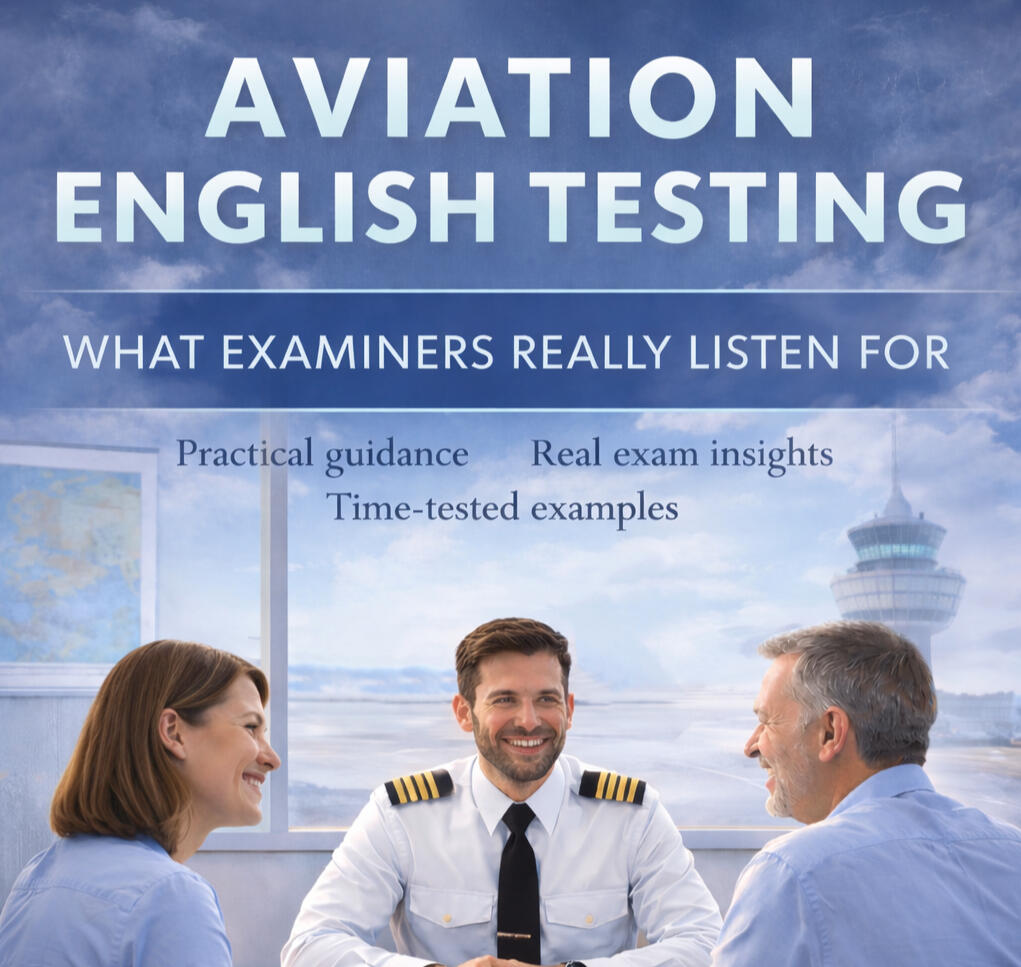
Aviation English Testing
What Examiners Really Listen For
Understand what language examiners really assessA practical, examiner-written guide to ICAO Aviation English testing - focused on real assessment decisions, not textbook theory.✔ Examiner insights
✔ Time-tested examples
✔ Common Level 4 killers
✔ Psychological preparation
✔ Checklist before the testWritten by an ICAO Language Proficiency Examiner • Aligned with ICAO Doc 9835
Why good English often doesn’t earn a pass
Many candidates fail ICAO language tests not because their English is poor - but because it does not give examiners enough reliable, assessable evidence.
Common situations:
• “I speak well, but I didn’t reach Level 4.”
• “I don’t know what examiners really listen for.”
• “My answers felt correct, but still not enough.”
• “Nobody clearly explained what is required for Level 4.”
What this book does differently
This book explains ICAO language testing from the examiner’s side of the table.
You will learn:
• What ICAO descriptors really measure in practice
• How to give answers that can be assessed - not guessed
• How to balance clarity, range, and operational relevance
• What a safe Level 4 performance actually sounds like
• What changes when moving from Level 4 to Level 5
No memorised scripts. No vague advice. Just clear examiner logic.
Inside the book
Introduction - What the test is really designed to measure
Overview
Chapter 1: What tests really test (and what they don’t)
Chapter 2: How much is enough? Sentence length, range, and control
Chapter 3: Pronunciation that works under pressure
Chapter 4: Grammar that helps you - not hurts you
Chapter 5: Vocabulary: precise, flexible, and operational
Chapter 6: Fluency is not speed
Chapter 7: Comprehension: understanding more than just the question
Chapter 8: Interaction: keeping communication alive
Chapter 9: What examiners disagree on
Chapter 10: Borderline decisions explained
Chapter 11: Common Level 4 killers (and how to avoid them)
Chapter 12: What a safe Level 4 performance really sounds like
Chapter 13: Crossing the line from Level 4 to Level 5
Chapter 14: How stress changes your English (and what to do about it)
Chapter 15: Psychological preparation with a focus on nonverbal communication
Quick Recap - What really matters at the end
Final checklist
How to use this checklist in the last 7 days before the test
Closing words
Human moments
Who this book is for
This book is for:
• Candidates preparing for ICAO language proficiency testing
• Level 3 candidates aiming for Level 4
• Aviation academies and flight schools
• Candidates who want clarity, not guessworkThis book is not for:
• General English learners
• Phraseology manuals
• Technical aviation theory training
• “Exam trick” shortcuts
See how the book works before you buy
Download a free PDF sample and review the structure, examples, and examiner notes.
Frequently asked questions (FAQ)
Is this an official ICAO publication?
No. This book is not published or endorsed by ICAO, but it is fully aligned with ICAO descriptors and Doc 9835.
Does this book guarantee Level 4 or higher?
No book can guarantee a result. This book helps candidates understand how performance is assessed.
Is this only for native speakers?
No. The book is designed primarily for non-native speakers.
Is this for pilots or ATCOs?
The focus is on candidates preparing for ICAO language testing, regardless of operational role.
If you want to understand what examiners actually listen for - and prepare with confidence instead of uncertainty:

About the authorMr. Krsman has worked in civil aviation since 2006 and is currently employed by the Civil Aviation Authority.He is an accredited ICAO Language Proficiency Examiner for Levels 4, 5, and 6 and has assessed a large number of candidates over the years.He has served as a national coordinator and national test administrator for ICAO Language Proficiency Requirements, with direct involvement in the organisation, administration, and oversight of language proficiency testing.
©2026 S. Krsman
This book is an independent publication and is not affiliated with or endorsed by ICAO.
All rights reserved.